 /
/ 


















Receive our latest arrivals of Region Champagne by email!
Sign up and be the first to know about new arrivals.

Would you like to create your own composition? Contact us!
 Contact us


Champagne spreads its vineyard some 150 kilometres east of Paris, on a chalk bedrock that defines its signature. Four main sectors structure it: the Montagne de Reims, the Vallée de la Marne, the Côte des Blancs and the Côte des Bar. From this northerly terroir come sparkling blends built on chardonnay, pinot noir and meunier, from vibrant brut to rosé, complemented by rare still wines.
Its great cuvées rank among the most sought-after bottles in the world. A Dom Pérignon 1993 or a Roederer Cristal 1996 speak to the precision of chalk-grown chardonnays, while the Krug Clos du Mesnil 1982 illustrates the art of the single-plot wine. Lovers of aged bottles also explore the 2008 vintage, taut and refined, the sunny 2012 vintage, or a 1990 wine now at full maturity.
Read moreFiltrer
Products (71)
Sign up and be the first to know about new arrivals.
Discover OUR SELECTIONS
The Champagne region is home to some of the most prestigious and iconic houses in the wine world. Among the essential references are Moët & Chandon, Dom Pérignon, Veuve Clicquot, Krug, Bollinger, Louis Roederer, Pol Roger, Taittinger, Perrier-Jouët and Ruinart. These great Champagne houses are recognised for the consistency of their cuvées, their historic savoir-faire and their ability to produce exceptional champagnes, appreciated by both enthusiasts and collectors alike.
Champagne is associated with prestige due to its history, its demanding production standards and its image of excellence. A symbol of celebration and elegance, it embodies a recognised art of living throughout the world.
The difference lies in the sugar dosage after disgorgement. A brut champagne is characterised by its freshness and balance, whilst an extra-brut offers a more tense and pure expression of the terroir. The demi-sec, more indulgent, ideally accompanies certain desserts or festive moments.
Long renowned for its still wines, Champagne built its identity around effervescence, the mastery of which asserted itself over the course of the 17th and 18th centuries with the development of secondary fermentation in the bottle. The production area was delimited by law in 1927, and the Champagne appellation was recognised in 1936; this strict framework established the authorised communes and the rules of cultivation. From this history emerged a unique model: that of the blend, in which each house or grower composes its style from different plots, grape varieties and sometimes different years. This pursuit of consistency and finesse, more than the bubble alone, underpins the Champenois identity and its status as the world reference for sparkling wines.
The vineyard extends over approximately 34,000 hectares spread across 319 communes, or crus, at altitudes ranging from around fifty metres to two or three hundred metres. Its northerly climate, at the crossroads of oceanic and continental influences, provides the coolness that gives Champagnes their acidity and backbone. The chalk subsoil, a white and porous rock, plays a decisive role: it drains excess water, releases it slowly in summer and reflects light onto the grape clusters. Four main sectors share the region: the Montagne de Reims, renowned for its full-bodied pinot noirs; the Côte des Blancs, the realm of chardonnay; the Vallée de la Marne, where meunier thrives; and the Côte des Bar, further south, also dominated by pinot noir. To explore these terroirs further, consult our article dedicated to the Champagne region.
The region has three appellations. The Champagne appellation covers the bulk of sparkling production; alongside it, the Coteaux Champenois designates still wines, red or white, and the Rosé des Riceys, produced on the Côte des Bar, is a rare still rosé. Within the Champagne appellation, a hierarchy of villages inherits the old échelle des crus: seventeen communes are classified grand cru and forty-two as premier cru, a distinction that rewards the historic quality of their terroirs. Our selection of grand cru classified Champagnes brings together these exceptional terroirs. Unlike Bordeaux, it is not an estate but the commune of origin of the grapes that carries the classification, which explains why a single house can draw on several crus for its blends.
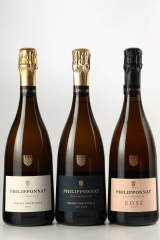
Three grape varieties dominate: pinot noir, the most widely planted across the region, provides structure and depth; meunier contributes roundness and fruit; chardonnay brings freshness and finesse. A few ancient and little-known varieties, such as arbane or petit meslier, survive on the margins. From this palette emerge several styles. The non-vintage brut, the heart of production, blends several years to deliver a consistent taste; blanc de blancs comes exclusively from chardonnay, such as this finely chiselled Deutz Blanc de Blancs 2010, while blanc de noirs, in the manner of a Philipponnat Blanc de Noirs 2019, draws its vinosity solely from black grapes. Rosé is obtained either by blending in a little red wine or by a short maceration of the skins. The dosage — that is, the small quantity of sugar added before finishing — finally defines the sensation on the palate: from extra-brut, almost sugar-free, to the balanced brut, through to the softer demi-sec.
Not all Champagnes age in the same way. A non-vintage brut is best enjoyed in the years following purchase, for its freshness; vintage cuvées and great prestige cuvées, on the other hand, gain in complexity over ten, twenty years or more, developing notes of dried fruit, brioche and honey. Chalk-based blanc de blancs are among those most suited to long ageing. To identify the most promising years, our vintage ratings compare regions year by year; a 2002 vintage in full evolution provides a fine illustration. The great Champagne terroirs enjoy long-standing and consistent international recognition, placing the region at the very top of the hierarchy of sparkling wines.
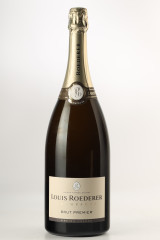
The region's renown owes much to its houses and growers, guardians of styles that are recognisable above all others. A few names have carried this reputation around the world: Krug, associated with rich, long-aged blends; Bollinger, renowned for the vinosity of its pinot noirs; Louis Roederer, whose Cristal cuvée ranks among the most sought-after prestige wines; Salon, a rare blanc de blancs from a single village on the Côte des Blancs; and also Deutz, Philipponnat, Pommery and Moët & Chandon, each defending their own signature style. Cuvées such as Dom Pérignon Brut 2002 embody this pursuit of precision and balance that has built the reputation of the great prestige cuvées. Behind every bottle one can read a blend, a choice of crus and a lees-ageing period unique to each signature. It is this diversity of hands and terroirs, from grand cru village to isolated plot, that gives Champagne its depth and sustains, vintage after vintage, its singular place among the great vineyards.
Ordering a Champagne from SoDivin means choosing an excellence service dedicated to lovers of great wines. Enjoy same-day dispatch for any order placed before 2 pm, with delivery as early as the next day. Every bottle receives special care, and our packaging ensures optimal protection during transit.
SoDivin also gives you the option of adding a personalised message as well as wooden gift boxes, ideal for giving on the occasion of a birthday or any other celebration. Furthermore, you have the choice of the dispatch date for delivery tailored to your needs. Our wines are stored under optimal conditions and you can view high-definition photos of each bottle online before purchasing, for complete transparency.


