 /
/ 

















Receive our latest arrivals of Château Mouton Rothschild by email!
Sign up and be the first to know about new arrivals.

Would you like to create your own composition? Contact us!
 Contact us


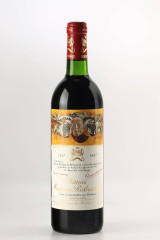
Château Mouton Rothschild reigns over the gravel plateau in the north of Pauillac, a stone's throw from its neighbour Lafite. Classified as a Deuxième Cru in 1855, it is the only estate to have obtained a revision of that classification, acceding to the rank of Premier Grand Cru Classé in 1973. Its vineyard of approximately 84 hectares is planted to more than four-fifths Cabernet Sauvignon, complemented by Merlot, Cabernet Franc and Petit Verdot. From this comes a dense and fragrant wine, in which ripe blackcurrant mingles with cedar, pencil lead and spices, and which is distinguished each year by a label signed by an artist, a tradition begun with the 1945 vintage.
The estate has produced some of the most sought-after reds of the past century, from the legendary 1945, 1959 and the 1961 vintage to the triumphant 1982 and 1996. This lineage extends into more recent years, such as the 2011 vintage, which provides access to the style of the cru at a more approachable stage of its evolution.
Read moreFiltrer
Products (19)
Sign up and be the first to know about new arrivals.
The modern adventure of the estate began in 1853, when Nathaniel de Rothschild acquired a Pauillac cru then known as Brane-Mouton and gave it his name. Two years later, the 1855 classification placed it among the Deuxièmes Crus, a verdict the family would contest for more than a century; its motto at the time summed up this wounded pride: "Premier ne puis, second ne daigne, Mouton suis." The turning point came in 1922, when Baron Philippe de Rothschild, aged twenty, took the reins of the property. From 1924, he had the entire harvest bottled at the château — a revolution at a time when grands crus were still sold in barrels to merchants — and entrusted the label of that vintage to a poster artist. After five decades of campaigning, the exception came in 1973: Mouton became the only cru promoted to Premier Grand Cru Classé since 1855, and its motto was rewritten as "Premier je suis, second je fus, Mouton ne change." Upon Baron Philippe's death in 1988, his daughter Baroness Philippine continued his work until 2014; her descendants run the estate today.
The vineyard of Château Mouton Rothschild extends over approximately 90 hectares in the northern part of the Pauillac appellation, on the edge of the Médoc peninsula. It rests on deep gravel ridges composed of pebbles and gravels, with a marl-limestone subsoil. These poor, perfectly draining soils are particularly well suited to viticulture and encourage a slow and regular ripening of the grapes.
The proximity of the Gironde estuary plays an essential regulatory role, tempering climatic extremes and ensuring great qualitative consistency from one vintage to the next. The positioning of the vines on gently undulating slopes optimises sunlight exposure and contributes to the natural balance of the wines produced.
The grape varieties at Château Mouton Rothschild are dominated by Cabernet Sauvignon, complemented by Merlot, Cabernet Franc and Petit Verdot. Vineyard work is based on a rigorous plot-by-plot approach, with controlled yields and constant attention paid to the optimal ripeness of the grapes. Vinifications are conducted with precision, followed by ageing in new oak barrels that accompanies the structure of the wine without altering its expression.
The wines of Château Mouton Rothschild are distinguished by their density, their controlled power and their aromatic richness. They generally offer a broad tannic framework, deep aromas of black fruits, spices and elegantly integrated woody notes, as well as a balance that allows them to evolve harmoniously over time.
Since 1945, Château Mouton Rothschild has also distinguished itself through its labels illustrated with original works by contemporary artists. This initiative, launched by Baron Philippe de Rothschild, contributes to the cultural identity of the estate without ever substituting itself for the qualitative demands of the wine. It reflects a singular vision in which artistic creation and winemaking tradition coexist durably.
Pauillac is the only appellation in the Médoc to bring together three Premiers Crus, which naturally invites comparison. Its direct neighbour to the north, Château Lafite Rothschild, cultivates a delicate, floral and restrained style, while Mouton embraces a richer and more expressive character. At the southern tip of the commune, Château Latour offers a severe power and an exceptional ageing potential, often more austere in its youth. Among the other classified growths in the area, Château Pichon Longueville Baron extends this Cabernet-dominated vein in a somewhat more accessible register. Placing Mouton within this neighbourhood illuminates its personality: that of a first growth that has never sought discretion and which contributes, in its flamboyant way, to the worldwide renown of Pauillac.


