 /
/ 


















Receive our latest arrivals of Saint Estèphe Appellation by email!
Sign up and be the first to know about new arrivals.

Would you like to create your own composition? Contact us!
 Contact us


At the northern tip of the Médoc, on the edge of the Gironde estuary, Saint-Estèphe is the largest of the great communal appellations on the left bank, alongside Pauillac, Saint-Julien and Margaux among the great wines of Bordeaux. On gravel ridges resting on a subsoil more clayey than its neighbours, cabernet sauvignon produces structured reds, supported by merlot, cabernet franc and petit verdot. Five properties feature in the 1855 classification, led by two second growths. These age-worthy wines open on dark fruit and spice before evolving towards leather and undergrowth: Château Cos d'Estournel 1988 and Château Montrose 1986 demonstrate this fully, with firm tannins and a deep structure. Enthusiasts also follow the 2009 and the 2010 vintage, two benchmark years for the appellation.
Read moreFiltrer
Products (42)
Sign up and be the first to know about new arrivals.
The Saint-Estèphe appellation is located in the north of the Médoc, on the left bank of Bordeaux, on the edge of the Gironde estuary. It is one of the great communal appellations of the Haut-Médoc, alongside Pauillac, Saint-Julien and Margaux.
Choisir un vin de Saint-Estèphe, c’est opter pour un grand vin de Bordeaux au style puissant, structuré et taillé pour la garde. L’appellation séduit les amateurs à la recherche de vins de caractère et d’un excellent potentiel d’évolution.
Les vins de Saint-Estèphe sont réputés pour leur puissance, leur structure tannique et leur profondeur. Dominés par le cabernet sauvignon, ils offrent des arômes de fruits noirs, d’épices et évoluent avec le temps vers des notes plus complexes de cuir et de sous-bois.
At the far northern end of the Médoc, the commune of Saint-Estèphe lends its name to the appellation that crowns the left bank of Bordeaux. Vines have been cultivated here for centuries, and the village had built a reputation for robust, long-lived wines well before the modern era. Officially recognised as an appellation d'origine contrôlée in 1936, Saint-Estèphe ranks among the great communal appellations of the Médoc, alongside Pauillac, Saint-Julien and Margaux. A mere stream separates it from Pauillac to the south: yet a few hundred metres is enough to change both soil and style. The appellation has no first growth, but five of its châteaux were distinguished in 1855, proof of a reputation already firmly established in the nineteenth century.
With nearly 1,230 hectares of vines, Saint-Estèphe is the largest of the four great communal appellations of the Médoc. Its terroir rests on the same gravel ridges as the rest of the peninsula — a mixture of pebbles, gravel and sand that drains water and retains heat — but its subsoil contains more clay than Pauillac or Saint-Julien. This distinctive feature changes everything: clay retains water and nourishes the vine even during dry summers, which explains the freshness and consistency of the wines from one year to the next. The oceanic climate, moderated by the body of water of the nearby Gironde, protects the vineyard from frost and extends the ripening of the grapes well into autumn. It is this combination of a cooler soil and slow ripening that shapes the structured character of the appellation. The detail of these sectors is explored further in our dedicated article on the Saint-Estèphe appellation.
Saint-Estèphe produces only red wine. Cabernet sauvignon dominates the blend: it is the variety that provides structure, aromatic depth and ageing potential. It is blended with merlot, which rounds out and softens the wine, then complemented by touches of cabernet franc and petit verdot, two varieties that add fragrance and freshness. The essence of the appellation lies in this blend: several grape varieties combined to balance power and finesse. In their youth, these wines tend to be firm, even austere, with a deep colour and tight tannins. Time transforms them: dark fruit and spice gradually give way to notes of leather, truffle and undergrowth. At the table, their structure calls for generous dishes — grilled red meat, a rack of lamb, game or a slow-cooked stew — while older bottles pair readily with mushrooms or aged cheeses.
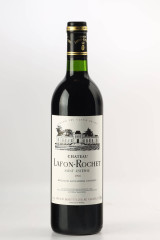
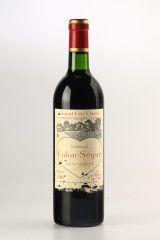
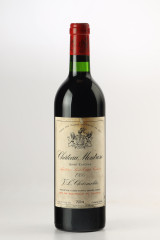
The 1855 classification, drawn up at the request of Napoleon III for the Universal Exhibition, ranks the châteaux of the Médoc across five tiers, from first to fifth grand cru classé. Saint-Estèphe has five properties listed. At the top, two deuxièmes crus classés: Cos d'Estournel, recognisable by its pagodas overlooking the estuary, and Château Montrose, situated facing the Gironde. Next comes a third growth, Calon Ségur, whose heart-shaped label recalls the attachment of its former owners; then a fourth growth, Lafon-Rochet, and a fifth growth, Cos Labory. The appellation therefore has no first growth, but this official hierarchy is deepened by a rare wealth of crus bourgeois — a category of quality châteaux selected outside the 1855 classification, which makes Saint-Estèphe one of their strongholds.
Ageing potential is one of Saint-Estèphe's greatest assets. Carried by firm tannins and fine balance, these wines easily cross one to two decades, and the finest growths develop over thirty years or more. With time, the structure softens, the tannins become supple and the palette gains in complexity, earning the appellation a reputation for exceptional longevity and a place among the benchmarks of the Médoc. Several vintages stand out as landmarks: 2000, 2005, 2009, 2010, then 2015 and 2016 produced wines that are both powerful and harmonious, while older vintages such as 1982, 1989 and 1990 continue to serve as references. The Saint-Estèphe 2016 and the 2000 red wine illustrate this consistency fifteen years apart. To place each year in context, our vintage guide details the style and potential of each.
Beyond the five classified growths, Saint-Estèphe's renown owes much to a network of estates that rank among the most reputed crus bourgeois in the Médoc. Phélan Ségur, a vast estate facing the estuary, produces consistent and distinguished wines that frequently rival the classified growths. Château Meyney, set on a clay-limestone hillside beside the Gironde, cultivates a dense and profound style inherited from a long monastic history. Haut-Marbuzet, finally, has built its reputation on a generous ageing in new oak barrels that gives it roundness and appeal. Together, these châteaux and the grands crus classés paint the portrait of an appellation where power never precludes finesse, and where every bottle bears the clay signature of the northern Médoc.


